homeabout WHRDactionsResourceslinkscontact


Content on this page requires a newer version of Adobe Flash Player.

Get Adobe Flash player


WHRD IC @ CSW
The Women Human Rights Defenders International Coalition and Cordaid, catholic organization for relief and development Invite you to meet women human rights defenders from Colombia, Uganda, OPT, India, the Philippines and Indonesia, countries that explicitly carry out counter terrorism measures. Learn about their responses and strategies. And share your experiences and thoughts.
WHRD IC @ HRC

The Women Human Rights Defenders International Coalition and Forum Asia invite you to a discussion about intimidation and reprisals against women human rights defenders for utilising UN Special Mechanisms.  The Panel will include UN Special Rapporteur on the Situation of Human Rights Defenders, Margaret Sekaggya.  Wednesday, 10 March 2010, 1pm-3pm, Room XXVII (27), Palais des Nations, Geneva.

For more information, contact Ms Giyoun Kim, Forum-Asia: una@forum-asia.org


Thursday 11 March 2010
, join the WHRD IC and partner human rights organisations for a discussion on the Protection and Security of Human Rights Defenders.


Albania: Petition in support of victims of violence against women and women's human rights defenders, February 2010


Fiji: Threats of reprisal for using UN Special Mechanisms


Iran: WLUML statement on Maryam Ghanbari, February 9, 2010

Uganda: , Women Activists Condemn the Brutal Arrest of IPC Womens League, 29 January 20


Fiji: End harassment of women human rights defenders

Iran: Arbitrary detention of “One Million Signatures” campaign members January 6, 2010

Solidarity with assaulted Patna social worker 24 December 2009


Respect Universality in Principle and Practice: Defend Women’s Human Rights, statement regarding Gita Sahgal, March 1, 2010.

WHRD IC Calendar 2010
A calendar of key human rights events of concern to women human rights defenders, noting important sites of advocacy and possible areas of intervention.


Haiti: WHRD IC policy recommendations, February 2, 2010
· English
· Creole

09 October 2009, FORUM-ASIA demands the release of four WHRDs in Burma

August 2009 WHRDs Condemn the Continuing Deprivation of Liberty of Daw Aung San Suu Kyi!


Archives


Archives


Respect Universality in Principle and Practice:  Defend Women’s Human Rights

March 1st, 2010

As women human rights defenders and members of the Women Human Rights Defenders International Coalition (WHRD IC), we note with grave concern the circumstances under which Gita Sahgal, a member of the WHRD IC Executive Committee and head of the Gender Unit of the International Secretariat of Amnesty International (AI), is currently under suspension on the same day that she publicly questioned  the specific alliances entered into by AI in its advocacy to defend victims of torture in Guantanamo Bay.  Read more


Roundtable Consultation on Partnering for Human Rights in the Commonwealth.

Civil Society Message to CHOGM 2009

Civil Society Organisations from across the Commonwealth and beyond met in London on 13

October 2009 and issued this message to the Commonwealth Heads of Government Meeting 2009

The credibility of the Commonwealth as a values based association is being seriously questioned.

Human rights and fundamental freedoms form an intrinsic part of Commonwealth Principles as enshrined in the 1971 Declaration of Commonwealth Principles and other subsequent Commonwealth communiqués and declarations.

The Harare Declaration and Millbrook Action Plan commit governments to observe and implement Human Rights as part of the Commonwealth’s fundamental political values. Security, climate change and financial stability can only be realized where there is genuine protection of human rights. The 2009 CHOGM is considering the theme “Partnering for a more Equitable and Sustainable Future." It must recognise that partnerships without human rights will lead to neither equity nor sustainability.

The Commonwealth is far from fulfilling its purpose as a champion of human rights. Many critical aspects of the Millbrook Action Plan are yet to be fully implemented.

In this context we urge that CHOGM should:

    1) Indicate real political will to strengthen human rights within the Commonwealth and call for demonstrable adherence by member states to international best practice standards of human rights.

    2) Expand the mandates of the Secretary-General’s Good Offices role and CMAG so that civil society is routinely actively involved in their work and they should refer to international human rights standards in dealing with countries that seriously or persistently violate human rights.

    3) Apply human rights criteria in selecting host countries for Commonwealth meetings with input from CMAG, the Human Rights Unit and broad-based civil society consultation.

    4) Further the implementation of its past commitments on civil society space at previous CHOGMs by ensuring their participation and representation in Commonwealth meetings and processes, especially those relating to human rights and mandate the Commonwealth Secretariat and the Commonwealth Foundation to this end.

    5) Call on the Secretary-General to take immediate action in the event of direct threats made by governments to Human Rights Defenders and civil society, particularly in light of the recent threats made by the President of The Gambia.

    6) Develop a public disclosure policy that will uphold the principle of maximum disclosure and ensure full transparency in all aspects of the Secretariat’s work.

    7) Strengthen the Human Rights Unit within the Secretariat by elevating it to the level of a Division.

    8) Recognise that currently there are no systems in place to comprehensively vet membership applications, and set up a mechanism that will carry out independent, comprehensive, and public reviews of the state of democracy and human rights in an applicant country so as to verify that Commonwealth membership standards have been satisfied.

    9) Establish a mechanism to measure the implementation of past human rights commitments and recommend ways of implementing them speedily.

    10) Call on member states that have not yet done so to begin or continue the process of realising international and regional human rights standards through ratification of treaties and by devising steps to implement those treaties.
Human Rights Defenders

CHOGM should:


Recognise the value and importance of the work of Human Rights Defenders, including women Human Rights Defenders. Any attack on them is an attack on the human rights of the whole society.

Reaffirm that Commonwealth countries have a duty to protect the life and liberty of Human Rights Defenders and respect their rights to freedom of association, movement, expression and information.

Urge Commonwealth states to commit to abide by the UN Declaration on Human Rights Defenders at international, regional and sub-regional levels and take steps for the domestic implementation of the Declaration. Member states should view Human Rights Defenders as key partners in implementing the human rights principles in the Harare Declaration.

Mandate the Secretariat to develop a Commonwealth-wide policy to protect Human Rights Defenders. To implement this policy the Secretariat should:
    1) Provide technical assistance to states in implementing international standards for the protection of Human Rights Defenders and the promotion of civil society.

    2) Partner with member states and civil society organisations to put in place National Human Rights Action Plans that include a comprehensive, practical step-by-step strategy for improving protection for Human Rights Defenders.

    3) Create a monitoring mechanism on the situation of Human Rights Defenders within the Commonwealth Secretariat’s Human Rights Unit which should also work to protect Human Rights Defenders at risk.


    Women Human Rights Defenders International Coalition

    Statement in Support of Mary Robinson, Presidential Medal of Honor Awardee

    Members of the Women Human Rights Defenders International Coalition (WHRD IC) join with numerous women’s rights and human rights organizations around the world to salute Mary Robinson’s accomplishments and to celebrate her Presidential Medal of Freedom Award.

    We commend the Obama Administration for awarding the US Medal of Freedom to former Irish President and UN High Commissioner for Human Rights (UNHCHR), Mary Robinson.  For many years now, Mary has been a strong and unwavering supporter of the slogan made famous at the 1995 Beijing UN Conference for Women: “Women’s Rights are Human Rights.”

    Both as President of Ireland, and later as UN High Commissioner for Human Rights, she served as a witness to human rights abuses around the world and brought dignity and integrity to the office and her dealings with all states and peoples.  As High Commissioner, Mary used her office to full effect, demonstrating to people around the world that a UN official can and should exemplify courage and compassion.

    Mary Robinson has long been a champion of the inherent dignity and equal rights of all people, particularly those whose voices are often marginalized – women and children. As a lawyer in her native Ireland, she brought landmark cases before the courts including legal actions that led to the removal of discrimination against children born out of wedlock, and the achievement of equal pay and opportunity for women in the workplace.

    We deplore the tactics of personal attacks, character assassination and misinformation launched by a variety of groups, including the American Israel Public Affairs Committee (AIPAC) and the Anti-Defamation League suggesting that she is not worthy of this medal.  In her numerous activities and leadership roles, Mary Robinson has been and remains a true agent of social change and is richly deserving of the Presidential Medal of Freedom.

    As a defender of women’s rights, Mary continues her work today in her capacity as a member of the Elders group, along with Desmond Tutu and Nelson Mandela, as well as her leadership of the Realizing Rights Initiative.  A recent Newsweek article states, “Obviously, she has been an indomitable defender of freedom across the globe.” 


    Women Human Rights Defenders
    International Coalition

    Solidarity Statement on the Global Day of Action for
    Human Rights in Iran

    25 July 2009

    On the occasion of the Global Day of Action for Human Rights in Iran, members of the Women Human Rights Defenders International Coalition (WHRD IC) express solidarity with the civil society in Iran in their struggle to demand that the leaders of the regime respect women’s rights and uphold their human rights as guaranteed in the Iranian constitution and in international human rights covenants that Iran has signed.

    As the protests over the disputed outcome of the presidential elections intensify, the Coalition is deeply concerned about the safety and security of the following women human rights defenders who have been arbitrarily arrested and still remain in detention for their courageous acts of advocating for women’s human rights and fundamental freedoms:

    • SHADI SADR, a human rights lawyer, journalist and a prominent women’s human rights advocate was abducted and violently arrested on 17 July;
    • ZHILA BANIYAGHOUB, a women’s human rights activist and journalist was arrested with her husband, Bahman Amouiee, also a women’s human rights activist and journalist, on 20 June;
    • SHIVA NAZARAHARI, also a women's rights and human rights activist and blogger, was arrested on 14 June;
    • Mahsa Amrabadi, a journalist and supporter of women's human rights, was arrested in her home on 14 June. She is pregnant and her husband, Masoud Bastani, a journalist, was arrested when he was following up her case in the judiciary on 5 July;
    • Hengameh Shahidi, a journalist and civil rights activist, was arrested on 18 June;
    • Zahra Touhidi, a student activist, was arrested in her home on 18 June. Her husband was arrested as well.
    • Somayeh Tohidlou, PhD student, blogger, member of the Mousavi Campaign, was arrested on 14 June.

    The WHRD IC is concerned by the arbitrary arrest and detention of Iranian women human rights defenders, in particular these seven women human rights defenders.  The members of the Coalition are further concerned that the arrest and detention of some of them might be related to their participation in campaigns against discriminatory laws and the peaceful defence of women human rights.

    The International Campaign for Human Rights in Iran cited eyewitness accounts of the leading role of women in standing up to government forces to protect those coming under attacks: “What was significant, in contrast to previous protests, was that people would not run away as they came under attack, but held their own. Particularly the women who would respond to the security forces said, ‘Why should we run? This is our country, this is our land, and we cannot be pushed out of our land. These sidewalks are ours. Who are you to tell us to go away, we shall not go.’

    The WHRD IC applauds and supports the efforts of the ‘Mothers of Peace’ and ‘Mothers Mourning’ that have protected activists under attack and organised silent protests for peace every Saturday to honour the activism of their killed, arrested or disappeared children in Iran.  In June, several of their members were arrested during one of their protests and were only released 2 or 3 days later.

    Women human rights defenders have been at the forefront in the defence of human rights and are entitled to the rights specified under the UN Declaration Human Rights Defenders and guaranteed under the International Covenant on Civil and Political Rights that Iran signed.  The continuing violent repression of internationally guaranteed human rights in Iran and the growing brutality in the hands of state agents of at least 4,000 reported to be detained, hundreds beaten and injured, and an unknown number of killed and those whose whereabouts are unknown, the WHRD IC is gravely concerned that unless the political issues are resolved with full respect for the rights and freedoms of the Iranian peoples, more women human rights defenders and other defenders will be put at risk.

    On this Day of Global Action for Human Rights in Iran, the members of the Women Human Rights Defenders International Coalition join the international human rights community to demand:

    1. The immediate and unconditional release of Shadi Sadr, Mahsa Amrabadi, Zhila Baniyaghoub, Shiva Nazarahari, Zahra Touhidi, Hengameh Shahidi, Somayeh Tohidlou and other women human rights defenders and all political prisoners and prisoners of conscience including students, journalists and civil society activists;

    2. The UN Secretary General to immediately appoint a delegation to travel to Iran to investigate the fate of prisoners as well as many disappeared persons;

    3. An end to State-sponsored violence and accountability for crimes committed by the State and its agents;

    4. Freedom of assembly, freedom of expression, and freedom of the press as guaranteed by the Iranian constitution and Iran’s obligations under international covenants it has signed.


    UPDATE

     Addressing Gaps in the Defense of Women Human Rights Defenders:  A Strategic Conversation

    The Center for Women’s Global Leadership (CWGL) in collaboration with the Women Human Rights Defenders International Coalition (WHRD IC) organized a strategic conversation on Addressing Gaps in the Defense of Women Human Rights Defenders from June 27-30, 2009.  About 30 women human rights leaders representing 25 organizations and 19 countries convened at the CWGL to discuss three thematic strands pertaining to gaps in the defense of women human rights defenders.  Depending on their personal expertise or interest, participants were divided into three working groups:  Families, Communities and Culture; Sexuality Baiting, the use of sexuality to attack women’s organizing; and Direct Accountability of Religious Fundamentalist Political Forces.    

    The working group on Families, Communities and Culture paid particular attention to the complicated roles of families and communities as both sources of support for women human rights defenders as well as common locations of abuse and violation.  Participants in this group noted the pressure that women human rights defenders face within their communities to uphold traditional roles which often run counter to their work as women human rights activists.  Nevertheless, the group affirmed that women are not products of the community, but part of the community themselves and therefore have a powerful and integral role in reclaiming and shaping the cultures that influence their communities and families.

    Participants in the working group on Sexuality Baiting discussed the ways antagonism towards activism around women’s and sexual rights work subject women human rights defenders to attacks.  Oftentimes, anti-sexist and anti-homophobic activism is looked upon as “coalition-breaking” or disuniting even by well-established international rights organizations.  Members of the working group noted that progress on sexuality baiting would not be made until the women human rights defenders community and its supporters became well-versed in language to resist baiting, especially those couched in religious or cultural terms.  The group particularly stressed the need for women human rights activists to recognize that sexuality baiting is not only the manipulation of prejudices in regards to sexual orientation, but is deeply connected to gender and therefore affects not only LGBT activists but even male and other human right defenders.

    Members of the working group on the Direct Accountability of Religious Fundamentalist Political Forces discussed the ways in which violations against women human rights defenders at the hands of religious fundamentalist forces have been “disappeared” in the international human rights arena. They noted that these fundamentalist entities are often deemed ‘untouchable’ at the hands of international human rights mechanisms due to their characteristics as both non-state actors and as religious or cultural entities.  The working group suggested the creation of mechanisms to expose and delegitimize the gendered nature of the violations committed by these groups through the documentation of threats as well as to consistently raise these issues to hold fundamentalist-terrorists and their supporters accountable for heinous violations against women and women human rights defenders.
    Participants agreed that new and creative strategies must be developed to address these particularly challenging issues.  They highlighted the need to develop conceptual and documentation tools and analyses and to actively promote the legitimacy of these concerns as human rights issues.  They asserted the right of women human rights defenders to define, create and interpret their own values and cultures and evolve new forms of accountability particularly for non-state perpetrators within families and communities, which are not addressed under existing UN and regional human rights mechanisms.   
     The participants affirmed that a coalition such as the WHRD IC is an important platform to foster sustained advocacy on women’s human rights across movements.  They made specific recommendations to the Coalition in terms of furthering the analyses and improving the documentation of these violations through the production of a documentation manual and a comprehensive report on the state of women human rights defenders, which is planned to be undertaken in collaboration with the UN Special Rapporteur on Human Rights Defenders.  The participants also endorsed the suggestion for the Coalition to develop a mechanism to monitor and improve the responses to urgent appeals for women human rights defenders at risk.  – by Ariana DasGupta
    Background materials on these issues discussed at the Strategic Conversation can be downloaded in English from CWGL’s website: 

    http://www.cwgl.rutgers.edu/globalcenter/policy/unadvocacy/whrd.html 


    Members of the Women Human Rights Defenders International Coalition deplore the systematic discrimination against lesbian, gay, bisexual and transgender (LGBT) people and activists in Uganda.  Such abuses violate fundamental human rights and endanger the lives of human rights defenders, including sexual rights defenders, in the country.

    In several acts since March 2009, right-wing religious and anti-gay groups have verbally attacked LGBT persons, by charging them with recruiting children into homosexuality; issuing slanderous remarks; and exposing in the media the names, places of employment and photos of more than 100 people suspected to be LGBT, including several LGBT rights defenders. An article in the leading tabloid The Red Pepper claimed to be exposing ”Uganda’s shameless men and unabashed women that have deliberately exported the western evils to our dear and sacred society.”  The strategic manipulation of prejudices about sexuality, known as sexuality baiting, is a dangerous practice that promotes negative stereotyping of LGBT persons and activists, increasing their vulnerability to acts of violence motivated by sexual orientation and gender identity in Uganda.

    Moreover, it is alarming that government officials have adopted similar rhetoric.  The New Vision, a Ugandan newspaper, reported that Chief Parliamentarian David Migereko stated that gays had exposed themselves, and the government would go after them.  "Homosexuality is illegal. The Minister of Ethics, Dr.  Nsabu Butoro, has been clear on the matter.  Those involved will face the long arm of the law." 

    The state’s discriminatory actions go beyond rhetoric. The police arrested at least five men on charges related to homosexual conduct.  Most have been charged with having ”carnal knowledge against the order of nature,” and one of the detainees has been charged with assaulting a minor and aggravated defilement, subject to the death penalty.

    Such discriminatory acts against LGBT and sexual rights defenders committed by state and private actors violate the freedom from discrimination enshrined in the Universal Declaration of Human Rights.  Additionally, the criminalization of homosexuality is contrary to Uganda’s obligations under the International Covenant on Civil and Political Rights, which protects the rights to freedom from discrimination (art. 2 and 26), freedom of expression (art. 19), freedom from arbitrary interference with the right to privacy (art. 17) and freedom of conscience (article 18). These acts are also contrary to the UN Declaration on Human Rights Defenders, which protects the human rights and freedoms of human rights defenders.

    Members of the Women Human Rights Defenders International Coalition call on the Government of Uganda to:

    • Adopt necessary legislation decriminalizing homosexuality in Uganda;
    • Uphold the human rights of LGBT persons and LGBT rights defenders and cease negative stereotyping of the LGBT community;
    • Stop the arrests of people based on their suspected homosexual sexual orientation and immediately release those who have been unfairly arrested on charges related to consensual same-sex relationships;  
    • End efforts to increase penalties for consensual same-sex relationships, or what is being referred to as 'homosexual recruitment.'


    April 9, 2009


    President Dr. Mahmoud Ahmadinejad
    The Presidency
    Palestine Avenue, Azerbaijan Intersection
    Tehran, Islamic Republic of Iran

    Your Excellency:

    We, the undersigned members of the Women Human Rights Defenders International Coalition, submit this statement to express our deepest concerns regarding the imprisonment of Alieh Eghdamdoost, as well as the recent arrest of 12 other human rights defenders in Iran.

    Alieh Eghdamdoost, together with dozens of other activists, was arrested at a women’s rights demonstration in Tehran in June 2006. On July 6, 2007, she was sentenced to a prison term of three years and four months, and 20 lashes. On appeal, the prison term was reduced by four months, and the judge overturned the lashings. Her sentence of three years is now being implemented, making her the first woman to have a sentence related to women’s rights activism actually implemented. Eghdamdoost was taken from her home on January 31, and has been held in Evin prison since. The fact that Eghdamdoost has been sentenced to a threeyear sentence that she is now forced to serve, while some others arrested on the same day faced no charges, were acquitted, or received suspended sentences, demonstrates the completely arbitrary nature of these judicial proceedings. Her imprisonment also sets a dangerous precedent for all women engaged in human rights activism in Iran.

    The implementation of Eghdamdoost’s sentence is taking place against a backdrop of increased repression of all human rights defenders, including women’s rights activists.

    Reliable sources have reported that on March 26 Iranian security forces detained 12 members of the One Million Signatures Campaign and Mothers for Peace, as they were sitting in their 2 / 3 cars on a street corner in Tehran, preparing to make New Year’s visits to the family members of some prisoners of conscience.

    The One Million Signatures Campaign, launched in August 2006, is a grassroots movement to raise awareness about gender-based discrimination in the law and to promote gender equality.

    Mothers for Peace are a diverse coalition of women seeking to promote a culture of peace in Iran and who condemn all forms of military aggression. Both groups employ peaceful methods to promote their message, whether through disseminating petitions, collecting signatures, or organizing and presenting lectures. As such, we consider members of both groups to be human rights defenders.

    The twelve individuals arrested on March 26 were: Ali Abdi, Delaram Ali, Bahara Behravan, Farkhondeh Ehtesabian, Shahla Forouzanfar, Arash Nasiri Eghbali, Mahboubeh Karami, Khadijeh Moghaddam, Leila Nazari, Amir Rashidi, Mohammad Shoorab, and Soraya Yousefi.

    After three days, ten of them were released on bail, but two activists, Mahboubeh Karami and Khadijeh Moghaddam, were kept in detention.

    On April 5, the ten released activists were charged with “disturbing of public opinion,” and “disruption of public order,” charges all ten deny.

    The two others, Karami and Moghaddam, who were also due to be arraigned on April 5, did not appear in court on that day. The deputy prosecutor informed their attorneys that they would be brought the following day, but in fact were kept in jail. In the end, Karami was released on April 7, and Moghaddam on April 8. Moghaddam faces charges in connection with a protest Mothers for Peace held on January 11, against Israeli attacks on the Gaza Strip.

    We strongly object to the arrest, detention and prosecution of these human rights defenders.
    The frequent arrest and prosecution of human rights defenders for non-violent exercise of their freedom of expression has been inconsistent with Iran’s obligations under international law.

    Even more concerning, based on the facts as we understand them, the persons arrested on March 26 were not engaged in a public activity, but were planning visits to private residences at the start of the New Year, as is customary amongst Iranians. The circumstances of their arrest simply do not even remotely support lodging charges such as “disrupting public order,” or “disturbing public opinion,” and appear as deliberate efforts to silence and intimidate these activists. We note, with great concern, that since the One Million Signatures Campaign has been launched, dozens of its members have been arrested, summoned for interrogation, monitored, banned from travel and prosecuted.

    The efforts of these activists to promote gender equality and a culture of peace should be applauded, not hampered. The U.N. Declaration on Human Rights Defenders stipulates that “everyone has the right, individually and in association with others, to promote and to strive 3 / 3 for the protection and realization of human rights and fundamental freedoms at the national and international levels.” The actions of the Iranian authorities stand in stark violation of this principle.

    We urge the authorities to reverse their ruling on Eghdamdoost’s case and release her from detention.

    Furthermore, we call upon the authorities in Iran to drop all charges against all 12 activists arrested on March 26, and further, to cease the repression and prosecution of all peaceful human rights defenders in Iran.

    Thank you for your attention to these urgent matters.

    Sincerely,


    Asia Pacific Forum on Women Law and Development

    Asian Forum for Human RIghts and Development (FORUM-ASIA)

    Baobab for Women’s Human Rights

    Front Line, The International Foundation for Human Rights Defenders

    Human Rights First

    International Campaign for Human Rights in Iran

    International Women's Rights Action Watch Asia Pacific

    Observatory for the Protection of Human Rights Defenders

    Women Human Rights Defenders International Coalition


    Statement on March 8, International Women’s Day

    The Women Human Rights Defenders International Coalition comprised of 18 international, regional and national women’s rights and human rights organisations, marks the occasion of March 8, International Women’s Day, by celebrating the courage of women human rights defenders around the world who challenge structures of discrimination and oppression that create environments conducive to human rights abuse.  In the context of the current economic recession, women human rights defenders’ access to defence and protection is affected by shrinking resources and makes the nature and range of the attacks against them ever more severe.

    Women human rights defenders, as defined by the Coalition, encompass both women active in human rights defence who are targeted for who they are as well as all those active in the defence of women's rights who are targeted for what they do. Simply, the term pertains to human rights activists who are women, as well as other activists including those who defend the rights of women and lesbian, gay, bisexual and transgender people; and uphold the universality of rights.

    In a survey conducted by the Coalition in 2008, women human rights defenders identified the most common violations they experienced as:  intimidation and harassment; surveillance and blacklisting; attacks and intimidation, including of family members; defamation, slander, vilification; killing and attempted killing. They suffer these abuses as forms of prejudice, exclusion and repudiation resulting from specific targeting by both state and non-state actors on various grounds, particularly where their promotion of human rights concerns is deemed controversial.  Attacks based on race, religion, ethnicity, gender, sexuality or gender identity, or combinations of these factors are very common.

    It is in this light that we note with great concern the statements of some countries which attempt to undermine existing commitments to accepted international human rights standards, in particular, non-discrimination based on gender and sexual orientation, that threaten the human rights of women human rights defenders including lesbian, gay, bisexual and transgender people.

    We also stress the importance of the work done by women human rights defenders to document, monitor and provide protection for those under attack for their religion or belief as well as for exercising their right to freedom of expression. We hold these two rights to be inter-dependent and mutually reinforcing and note that attempts to limit them on grounds of ‘defamation of religion’ will undermine existing standards, and hinder the work of defenders by legitimising targeted attacks on them.

    We urge the UN system and member states to strengthen the UN’s work for the fulfilment of women’s human rights, particularly through strengthening the gender equality architecture at the UN.

    We welcome the commitment made by the UN Special Rapporteur on Human Rights Defenders to include the specific concerns of women human rights defenders in the priorities of her mandate. We support her efforts to sustain and broaden institutions for the protection of human rights defenders and affirm the need for continuing collaboration between the human rights defenders’ mandate and all other human rights mechanisms, including the Universal Periodic Review, to strengthen the protection of defenders. 

    We further call on States to uphold their obligations under the human rights treaties and to continue funding of programmes for the advancement of women’s human rights especially during the current financial crisis.

    For more information, contact:

    Mary Jane N.  Real
    Women Human Rights Defenders International Coalition
    c/o Center for Women's Global Leadership
    Rutgers, The State University of New Jersey
    160 Ryders Lane
    New Brunswick, NJ 08901-8555 USA
    Tel. + 1 732 932 8782 ext. 602
    Mobile Phone No.:  1 848 667 0908
    email:  whrd@apwld.org
    skpe:   maryjanereal1


    _________________________________________________________

    Amnesty International (AI), Asian Forum for Human Rights and Development (Forum Asia), Asia Pacific Forum on Women, Law and Development (APWLD), Center for Women's Global Leadership (CWGL), Front Line, Information Monitor (Inform), International Service for Human Rights (ISHR), ISIS-Women's International Cross-Cultural Exchange (ISIS-WICCE), The Latin American and Caribbean Committee for the Defense of Women's Rights  (CLADEM), Women Living Under Muslim Laws (WLUML), World Organisation Against Torture (OMCT), Association for Women’s Rights in Development (AWID), Baobab for Women’s Human Rights, Human Rights First, International Federation of Human Rights (FIDH), MADRE (an international women’s human rights organisation), Urgent Action Fund for Women’s Human Rights (UAF), Women’s Initiative for Gender Justice (WIGJ)

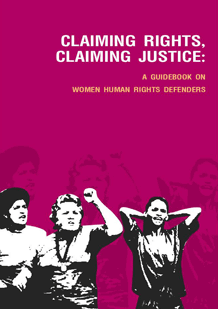
    Claiming Rights, Claiming Justice: A Guidebook on Women Human Rights Defenders


    A Guidebook on Women Human Rights Defenders is aimed to help women human rights defenders name the specific risks, violations and constraints they face in their work.  It presents a practical discussion of the useful mechanisms developed by the state and also the civil society to provide redress and remedy, and to protect women human rights defenders.  It is intended to be used by human rights and other organisations to further a gender perspective in the monitoring and documentation of human rights. 

    The guidebook was produced by APWLD in close collaboration with individuals and organisations that participated in the international campaign on women human rights defenders since 2005. Printed copies are for sale at 25USD including postage. For orders please contact APWLD at Phone numbers: (66) 53 284527, 284856
    Fax:  +66 53 280847 email:  apwld@apwld.org.


    CELEBRATING WOMEN'S RESISTANCE!
    Following is the video shown at the opening of the International Consulation on Women Human Rights Defenders held in Colombo, Sri Lanka on 29 - 2 December 2005. The video is produced by Young Asia Television, Sri Lanka on behalf of the Women Human Rights Defenders' International Coordinating Committee.

    The video is a tribute to all women human rights defenders who have been killed in defense of human rights and to many women activists and defenders of women's rights who continue to advocate for the realisation of all human rights for all.

    The video is in English, French and Spanish version. Please download and use it for your March 8 activities or any other mobilisation around women's human rights, as we continue to celebrate women's resistance!